

Over the past year, the United States has experienced rapid shifts in public policy, from the economy to health care.1 2 3 These policy shifts shape the properties of places and institutions, which determine the vital conditions for health and well-being — such as housing, food, health care, and civic participation — that we all need to be able to reach our full health potential.4 Understanding public sentiment about health, well-being, and the nation’s direction during times of change provides insight into the impact of those changes on the public’s ability to stay healthy.5 Identifying shifts in public sentiment is essential to effective public health practice, from addressing emerging health crises to shaping policy and designing communication strategies.6 7 When sentiment declines, it can indicate worsening community conditions and highlight where interventions, support, or policy adjustments may be needed to protect the public’s health and ability to thrive.5
In October 2025 the AAMC Center for Health Justice polled a nationally representative sample of 5,079 adults (ages 18-plus). The online survey asked about overall health and well-being as well as personal and community-level conditions. It also assessed public sentiment on issues affecting the nation, and support for and participation in related civic-engagement activities.8
How do U.S. adults feel about their health, circumstances, and who is struggling?
The survey asked respondents to share how they felt compared with a year ago. About one-fifth of adults reported worse mental health (23%), physical health (22%), and overall well-being (23%), as well as higher levels of stress (35%). Those who reported worsened states were more likely to be women, white adults, individuals with a liberal political ideology, individuals making less than $50,000 per year, individuals without a college degree, and those living in rural areas.
Despite those declines, about a third of adults reported improvements in mental health (32%), physical health (35%), overall well-being (37%), and stress (29%). Those who reported improvements were more likely to be men, individuals who identify as Black, those who earned more than $100,000 annually, individuals with postgraduate degrees, and those residing in urban areas (Figure 1; Supplemental Table 1).
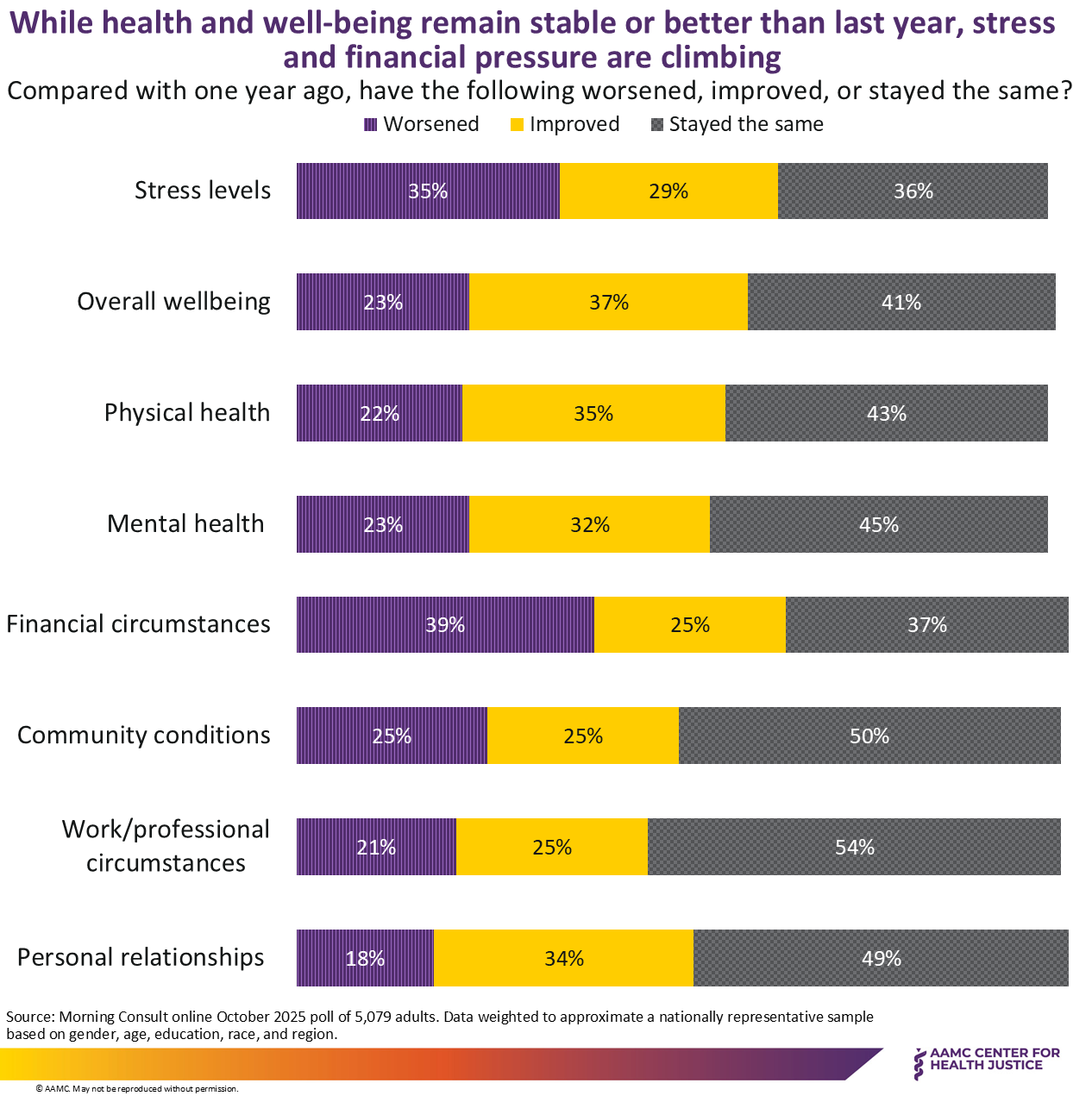
Figure 1
Beyond health: personal relationships, finances, work, and community
Respondents were asked about changes in areas of life beyond health. Over the past year, financial circumstances worsened for 39% of adults; community conditions and work/professional circumstances worsened for 21%; and personal relationships worsened for 18% of adults. Women, white adults, single adults, Gen Xers, those with liberal political views, lower earners (under $50,000 per year), those without a college degree, and rural residents were more likely to report worsening financial circumstances. At least one-quarter of U.S. adults reported improvements in each of these non-health related conditions (Supplemental Table 2).
For those whose circumstances either improved or worsened over the past 12 months, we asked why. The predominant answer was “My own choices” for personal relationships, financial circumstances, work/professional circumstances, and, to a lesser extent, community conditions (Figure 2). Men and Asian adults were more likely than others to attribute changes to their own choices/behaviors across all areas. Overall, those who experienced worsened personal circumstances selected factors other than “My own choices” as the reason (Supplemental Table 3). Respondents reported that government policies played a larger role in changing community conditions than they did for personal, financial, and professional circumstances.
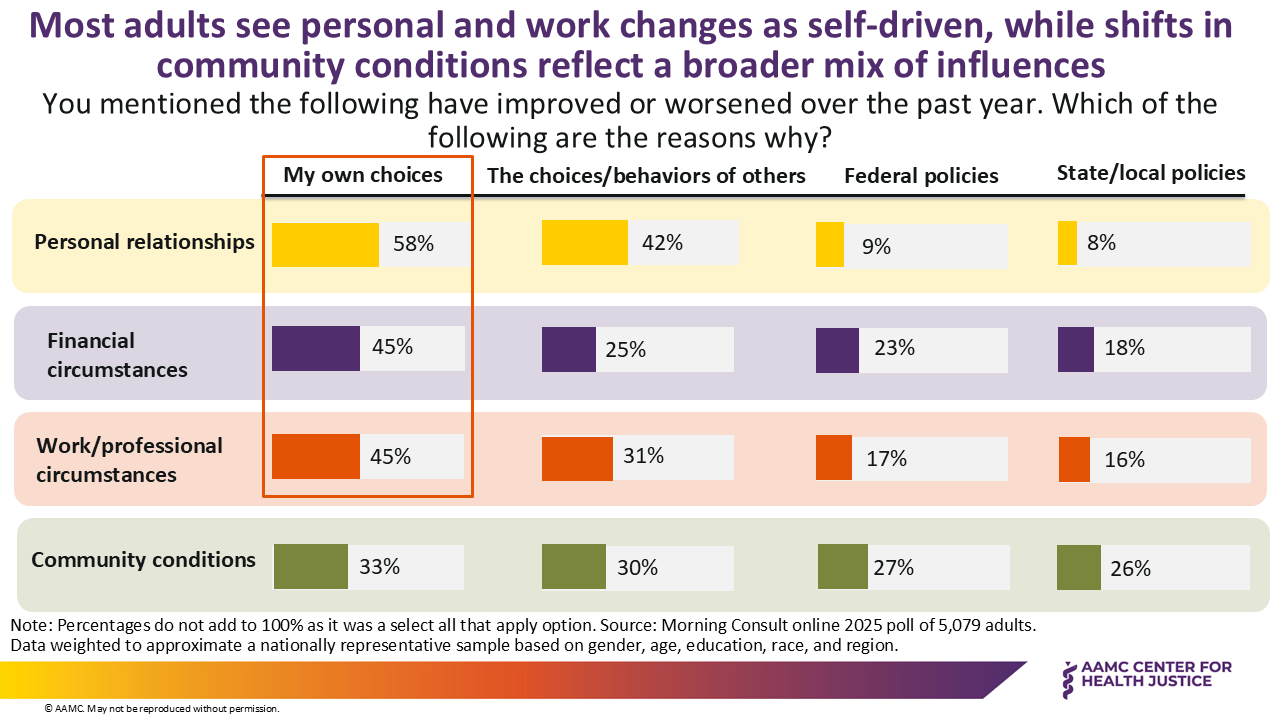
Figure 2
How do U.S. adults feel about the state of the nation?
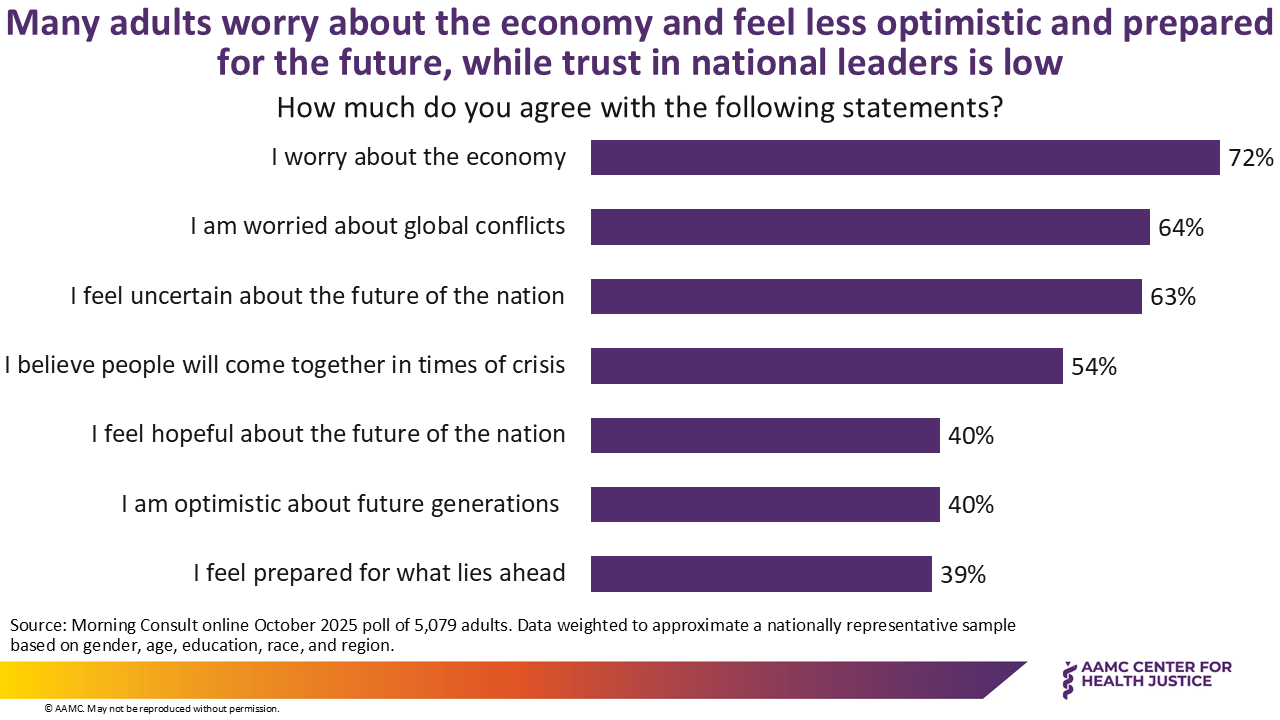
When asked about the state of the nation, U.S. adults expressed broad worries. Nearly 3 in 4 worried about the economy (72%), and roughly two-thirds worried about global conflicts (64%) and uncertainty about the future (63%). Fewer than half of respondents felt hopeful (40%), felt optimistic about future generations (40%), or felt prepared for what lies ahead (39%; Figure 3). Men and those with conservative political views reported higher levels of hope and optimism. Generally, those who experienced worsened health and well-being or personal circumstances were more pessimistic about the nation (Supplemental Table 4).
U.S. adults know what their communities need to thrive
When it comes to the foundational conditions that make communities healthy — what community leaders, health organizations, policymakers, nonprofits, and researchers call the vital conditions — U.S. adults are remarkably aligned. The majority of respondents consistently rated all vital conditions as important, with support exceeding 80% for each (Table 1). Support was especially strong among baby boomers, liberal-identifying adults, those earning over $50,000 per year, and those with postgraduate education (Supplemental Table 5).
Table 1. To improve your community’s health and well-being, how important are each of the following?
| Vital Condition | Important |
|---|---|
| Ensuring access to affordable, high-quality health care | 89% |
| Increasing access to affordable, nutritious food | 88% |
| Ensuring access to clean air, water, and soil | 88% |
| Protecting civil and human rights | 87% |
| Providing high-quality education for all ages | 87% |
| Ensuring freedom from violence | 87% |
| Developing affordable, humane housing | 87% |
| Expanding opportunities for meaningful and well-paid work | 87% |
| Providing reliable and affordable transportation | 84% |
| Helping people save money and build wealth | 82% |
| Protecting opportunities for civic engagement | 80% |
U.S. adults believe the government is responsible for addressing living conditions
When respondents who deemed these vital conditions as important were asked to identify who should take primary responsibility for addressing them, the federal government featured most prominently among respondents (range: 21%-58%), followed by local or state governments (range: 18%-48%), individuals and households (range: 6%-24%), and community-based organizations (range: 5%-12%). Businesses (range: 3%-13%), as well as nonprofits or foundations (range: 3%-6%), had a smaller role to play, according to the respondents, with the notable exception of “expanding the opportunities for meaningful and well-paid work,” where more than a fifth of adults surveyed (23%) identified the private sector as bearing significant responsibility (Figure 4). Those who identified with a liberal ideology endorsed the idea that the federal government was responsible for ensuring the vital conditions more than their moderate or conservative counterparts (Supplemental Table 6).
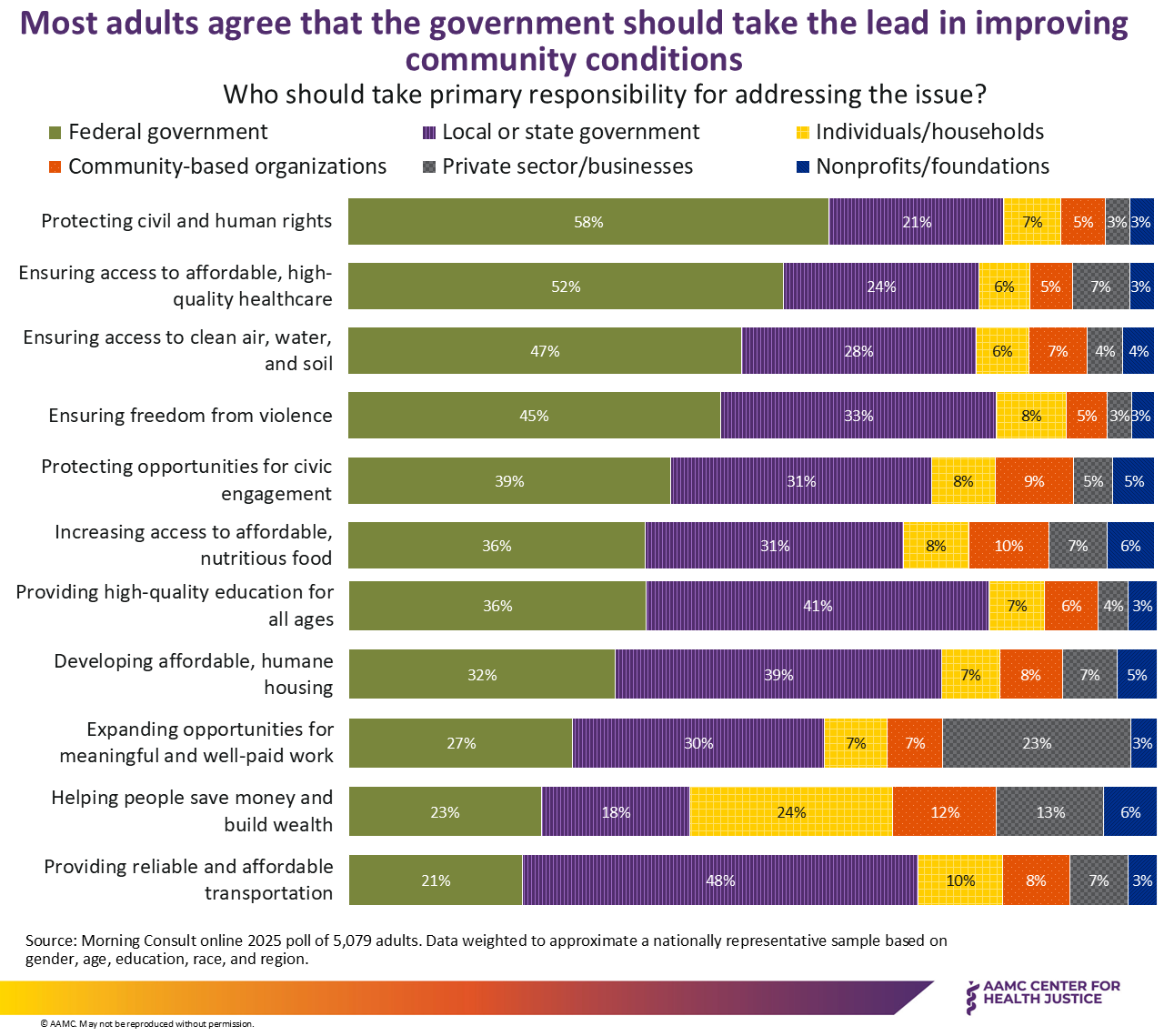
Figure 4
What do U.S. adults believe can influence government action?
If respondents believe that the government bears primary responsibility for ensuring the vital conditions, what does it take to hold it accountable? Respondents rated the effectiveness of civic- engagement activities in influencing government action. Voting in local and state elections (74%) and federal elections (73%) were viewed as the most effective. Roughly 6 in 10 respondents considered volunteering at community-based or advocacy organizations (61%), directly contacting elected officials (59%), and donating to charities aligned with personal priorities (58%) as additional effective actions. Attending marches and rallies was the form of civic engagement least likely to be seen as effective (46%) (Figure 5).
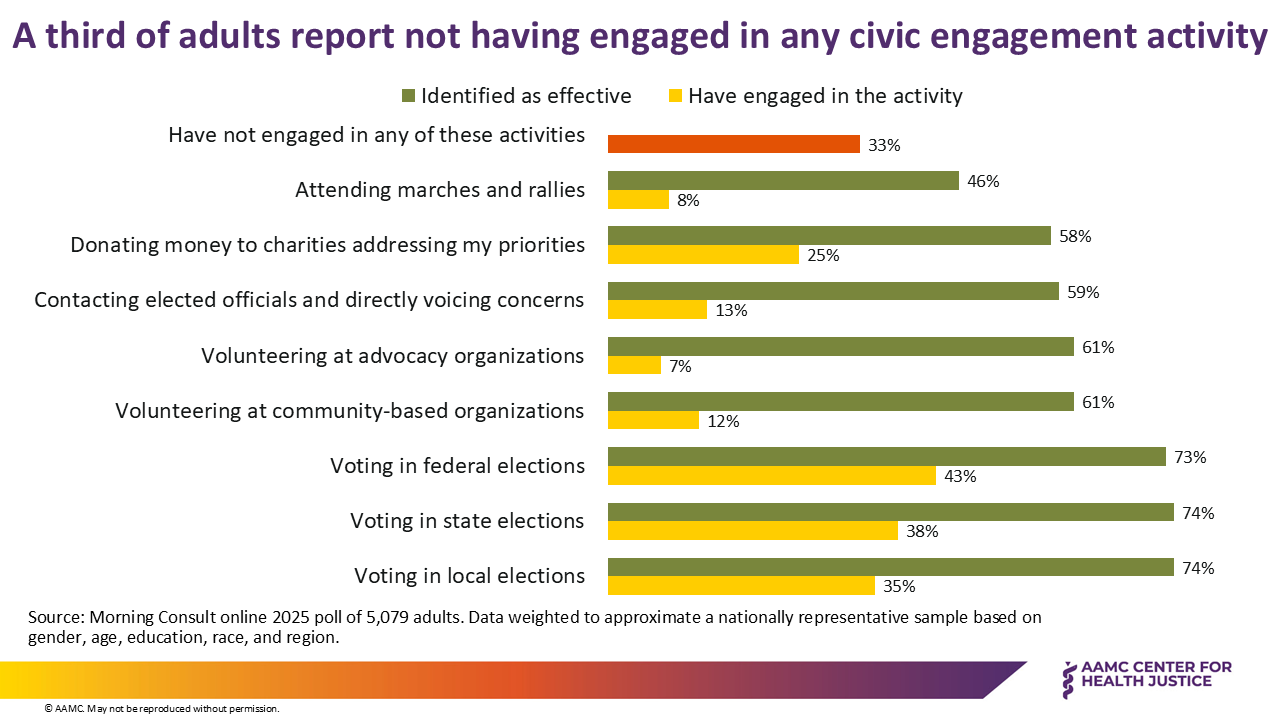
Figure 5
Liberal-identifying adults, higher earners (over $100,000 annually), and those with postgraduate degrees expressed the greatest confidence in civic engagement across all activities. Black adults were more likely than white adults to view most civic actions as effective, with one notable exception: Both groups rated voting in elections equally. Ideological moderates reported the least confidence in civic action overall, except "volunteering at advocacy organizations" and "attending marches and rallies," in which conservatives were even less confident. Urban residents were more confident in civic action across the board, except for local- and state-election voting, where suburban residents led (Supplemental Table 7).
Are people doing the kinds of civic work they believe in?
Despite respondents’ general confidence in civic engagement, their actions lagged behind their beliefs. At most, over the past year, two-thirds had participated in any of the civic-engagement activities they deemed effective, and a third reported not having engaged in any of them. The civically disengaged group skewed toward women, white respondents, unmarried adults, millennials, those with moderate political views, higher earners (over $100,000 per year), and those without a college degree. Across every activity in Figure 5, participation rates lagged well behind perceived effectiveness (Supplemental Table 8).
Ensuring all communities have a fair and just opportunity to thrive
The survey findings paint a complicated picture. Roughly 1 in 5 to 1 in 3 Americans reported that their physical health, mental health, well-being, and financial circumstances worsened over the past year, even as a comparable share reported improvements. Most respondents attributed these changes to personal choices, reflecting a deep individualist strain in American culture. Simultaneously, a self-reliance narrative exists alongside the broader anxiety expressed by these same respondents: Nearly 3 in 4 worry about the economy, and fewer than half feel hopeful about the nation’s future.
This tension between individual experiences and collective concern is constant throughout the results. U.S. adults overwhelmingly affirm that the vital conditions — such as health care, housing, clean environments, education, and economic opportunity — are essential to community health, and they hold government accountable for delivering them. Most also believe that civic engagement can move the needle. Yet belief has not translated into action: A third of adults participated in no civic activity whatsoever in the past year, and even voting — the most fundamental form of political participation, was practiced by fewer than half of those who called it effective, a gap with real consequences for health.
We know civic engagement is not just about participating in the political process; it is a structural determinant of health. Participation strengthens social capital, builds trust, and creates the community environments — safer neighborhoods, better food access, and stronger social cohesion — that enable people and communities to thrive.9 Civic engagement also positively impacts people’s health. Research shows that civic engagement in adolescence and early adulthood predicts later mental health, health behaviors, and socioeconomic outcomes, even after accounting for early life conditions.10 11 Yet, civic involvement is skewed by social and economic factors. Long-standing inequities in civic opportunity and access mean that the communities with the most to gain from strong government responsiveness are often those least able to make their voices heard.12
The subgroups identified among the civically disengaged — women, white adults, unmarried individuals, millennials, those with moderate ideologies, higher earners, and those without college degrees — offer a road map for focused, intentional outreach. Reaching these communities requires showing up and engaging people where they are, through deliberative resident assemblies, community-led dialogue, engagement outside city hall, and accessible digital tools and technology that lower the barriers to participation and elevate a range of voices. Ensuring a fair and just opportunity to thrive demands not only that we strengthen the vital conditions for health, but that we build the inclusive civic infrastructure through which communities can hold leaders accountable for delivering them.
Voter turnout for the 2024 presidential election, though the highest in recent history, was still only 65%,13 leaving substantial room for meaningful intervention.14 Different sectors have distinct entry points. In the health care sector, get-out-the-vote efforts such as Vote-ER can help improve voter turnout with nonpartisan voter education and registration. Health care‑based voter-registration efforts can reach people who are routinely overlooked by political campaigns and other conventional outreach strategies. By embedding registration opportunities in trusted care settings, these initiatives connect with patients who may have limited contact with traditional civic mobilization efforts. Building institutional and organizational trust through tools like the AAMC Center for Health Justice’s Principles of Trustworthiness Toolkit is a strategy that can foster transparency and accountability, which are critical foundations for meaningful civic engagement and, ultimately, improved health outcomes for all.
- Rugaber C. Consumer confidence slides as Americans grow wary of high costs and sluggish job gains. AP News. November 25, 2025. https://apnews.com/article/consumer-confidence-economy-55848421b5ff33ed244c8a4291f7facf. Back to text ↑
- Changes to Medicaid, the ACA, and other key provisions of the One Big Beautiful Bill Act. American Medical Association. September 11, 2025. https://www.ama-assn.org/health-care-advocacy/federal-advocacy/changes-medicaid-aca-and-other-key-p…. Back to text ↑
- Hutzler A, Singh N. Government shutdown timeline: How senators went from 40-day impasse to sudden deal. ABC News. November 10, 2025. https://abcnews.go.com/Politics/government-shutdown-timeline-senators-40-day-impasse-sudden/story?i…. Back to text ↑
- Vital conditions for health and well-being. The Rippel Foundation. December 4, 2024. https://rippel.org/vital-conditions. Back to text ↑
- Stress in America 2023. American Psychological Association. November 2023. https://www.apa.org/news/press/releases/stress/2023/collective-trauma-recovery. Back to text ↑
- Prasinos M, Basdekis I, Anisetti M, Spanoudakis G, Koutsouris D, Damiani E. A modelling framework for evidence-based public health policy making. J-BHI. 2022;26(5):2388-2399. doi: https://doi.org/10.1109/jbhi.2022.3142503. Back to text ↑
- Nayak A, Raghatate KS. Health policy reforms and their effect on healthcare delivery: Utilizing natural language processing (NLP) to analyze public sentiment and policy feedback. SEEJPH. August 29, 2024:359-367. doi: https://doi.org/10.70135/seejph.vi.713. Back to text ↑
- Note: This survey was collected during the 2025 federal-government shutdown, which started on October 1, 2025. Back to text ↑
- Civic participation. Healthy People 2030. U.S. Dept. of Health and Human Services. 2016. https://odphp.health.gov/healthypeople/priority-areas/social-determinants-health/literature-summari…. Back to text ↑
- Ballard PJ, Hoyt LT, Pachucki MC. Impacts of adolescent and young adult civic engagement on health and socioeconomic status in adulthood. Child Dev. 2018;90(4). doi: https://doi.org/10.1111/cdev.12998. Back to text ↑
- Flanagan C, Levine P. Civic engagement and the transition to adulthood. Future Child. 2010;20(1):159-179. doi: https://doi.org/10.1353/foc.0.0043. Back to text ↑
- Adams J. The imperative link between civic engagement and public health: insights from a former U.S. surgeon general. Am J Public Health. 2025;115(3):313-315. doi: https://doi.org/10.2105/ajph.2024.307995. Back to text ↑
- 2024 presidential election voting and registration tables now available. U.S. Census Bureau. April 30, 2025. https://www.census.gov/newsroom/press-releases/2025/2024-presidential-election-voting-registration-…. Back to text ↑
- Son B, Bellinger N. The health cost of autocratization. J Dev Stud. 2021;58(5):873-890. doi: https://doi.org/10.1080/00220388.2021.2017891. Back to text ↑