
Trust is foundational for health and happiness, impacting our bodies by reducing stress;1 our communities, by supporting social cohesion and cooperation;2 and our democracy, by improving our sense of belonging.2 Higher levels of trust are associated with a lower probability of self-reported poor health,2 3 and with longer life.3 4 In recent years, however, there has been a steep decline in trust in institutions among U.S. adults.5 6 7
Lack of trust has been identified as an important barrier to health-promoting behaviors, such as using preventive care,8 adherence to medical treatment, 9 10 and regimens,11 12 and participation in clinical trials and research.13 14 15 Lack of trust is not distributed evenly, and is more pronounced among Black16 and Hispanic17 populations, as well as the LGBTQ+ community,18 contributing to persistent health and health care inequities.
Because trustworthiness enables the meaningful community collaborations19 needed to advance health equity, ensuring all communities have a fair and just opportunity to thrive, the AAMC Center for Health Justice has tracked national trends in trust since 2021. In July 2026, the Center commissioned an online survey of a nationally representative sample of 2,285 adults. This poll explored public trust across multiple institutions and sectors. It also assessed how trust informs individuals’ health-related choices and behaviors, and explored which actions, if any, may help restore public trust in our institutions.
Trust trends continue to decline
Since 2021, the Center has asked U.S. adults how much they trust nine different types of institutions to “serve everyone in your local community fairly.” The nine categories of institutions are fire departments, libraries, hospitals, pharmacies, public health departments, local schools, police departments, universities, and social service agencies. While all nine types of institutions remain more trusted than not, our polling trends show a marked decline in public trust since 2021, across all institutions except local schools. By 2026, the sharpest drops were seen for fire departments (down 10-percentage points from 2021), pharmacies (down 10-percentage points), and libraries (down 8-percentage points). (See Figure 1.)
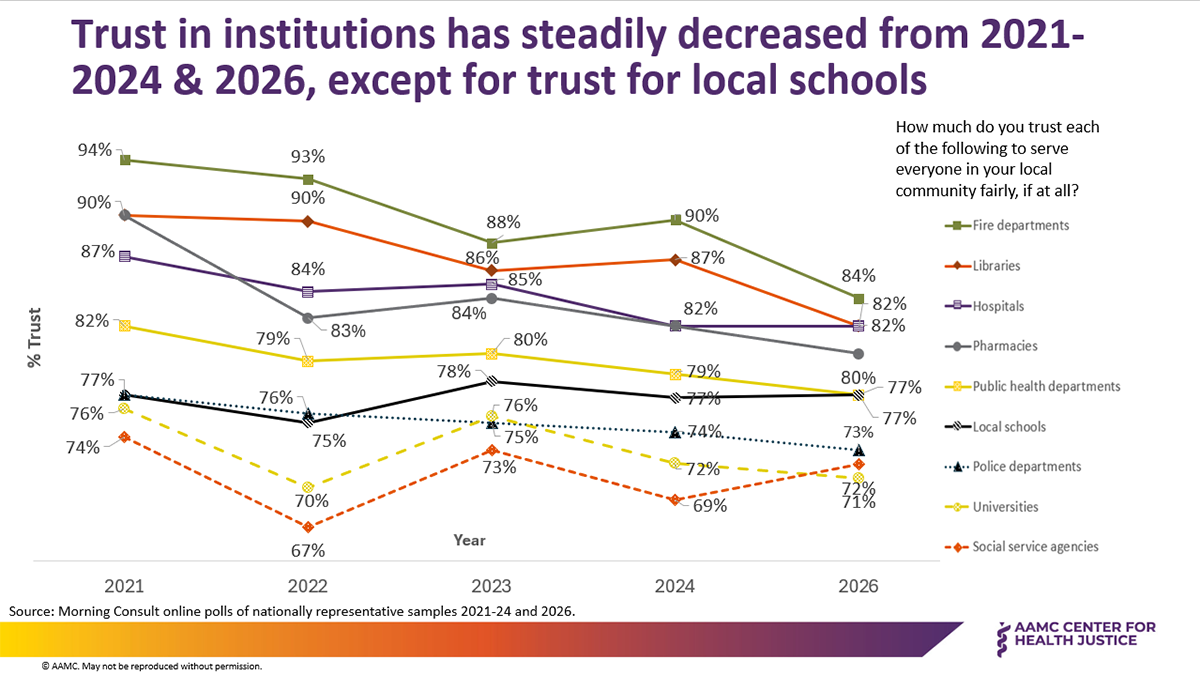
Figure 1
The federal-local-professional trust gaps
The survey also compared respondents’ trust in local professionals (teachers, doctors, pharmacists, etc.) with the institutions they work for (local schools, hospitals, pharmacies, etc.) and the federal agencies that oversee their sector’s work (the U.S. Department of Education, the Centers for Medicare & Medicaid Services, the Food and Drug Administration, etc.). Five sectors (the pharmaceutical industry, public health, education, health care, and research) of the nine that the Center tracks were assessed in this way.
Across categories, respondents were significantly more trusting of local organizations than of those organizations’ federal counterparts. (See Figure 2.) Baby boomers, those with an income higher than $50,000, the medically insured, registered voters, and those with at least a high school diploma were more likely to trust local agencies over federal ones.
However, trust in local institutions did not extend to the individuals working within them; professionals were less trusted than their local organizations for all five sectors assessed. The greatest differences were between local public health leaders and the government departments for which they work (11%), and between university researchers and their universities (6%).
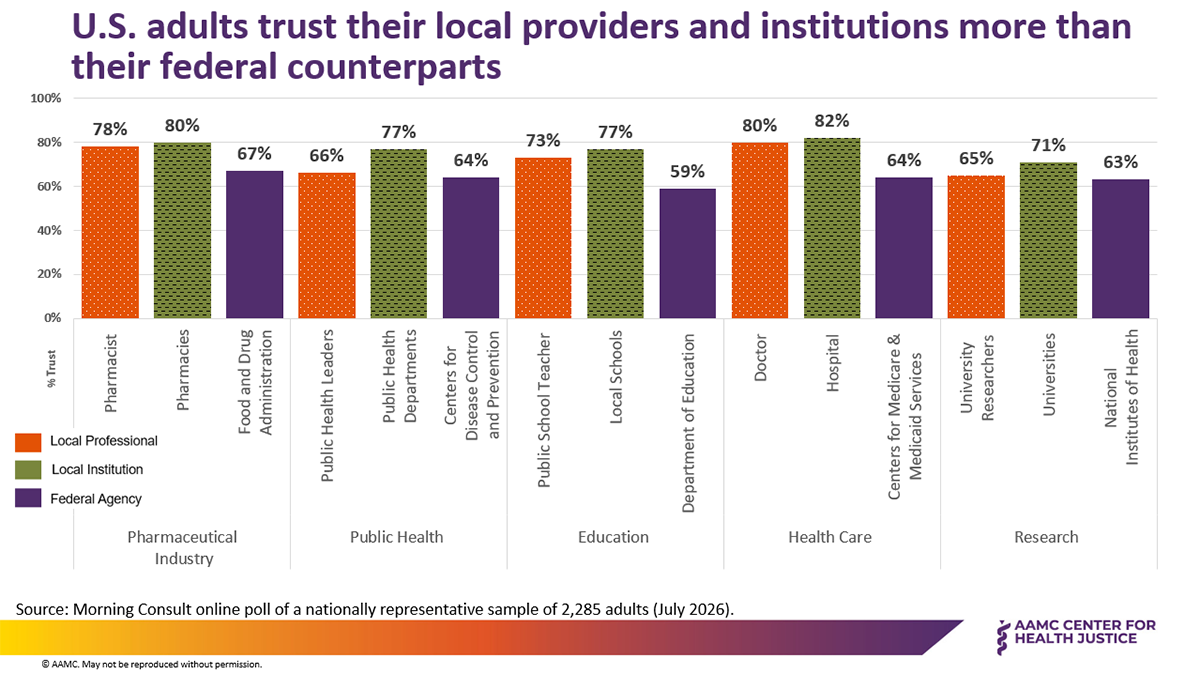
Figure 2
Lack of trust changes health-related behaviors and actions
Half (50%) of U.S. adults believe there are organized efforts to make people distrust health institutions and experts, while 20% are “Not sure” (data not shown). Those more likely to believe in such efforts were millennials and Gen Zers, those who identify as Hispanic or Black, registered voters, those residing in urban areas, those with a self-reported liberal political ideology, and those reporting excellent health.
The poll asked respondents which, if any, of 14 health-related actions and behaviors they have delayed or avoided in the past year because of a lack of trust. Fifty-nine percent selected at least one, and 31% selected between two and four.
The most frequently avoided or delayed behaviors were drinking tap water, eating certain processed foods, getting a vaccine or a booster, eating certain fruits or vegetables, going to a doctor, and filling a prescribed medication. (See Figure 3.) The subgroups more likely to avoid or delay multiple behaviors were millennials, Gen Zers and Gen Xers, those who identified as Black, those who resided in urban settings, and those holding moderate or conservative political ideologies.
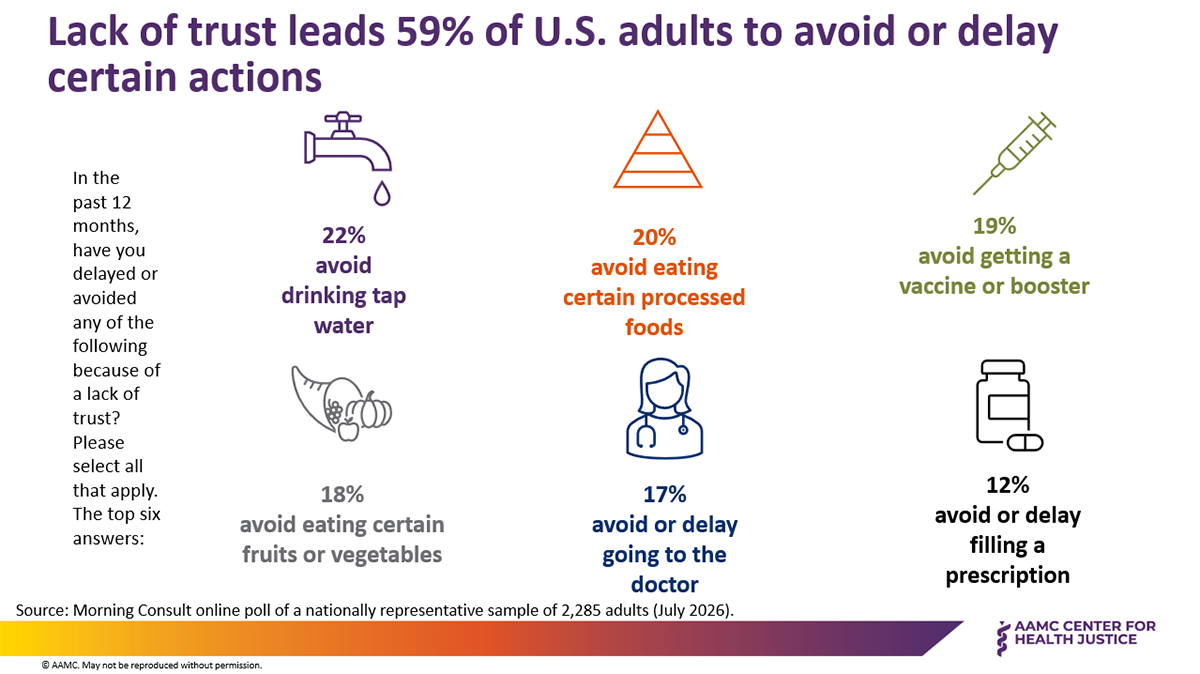
Figure 3
Actions that may help rebuild trust
The Center’s Principles of Trustworthiness Toolkit, launched in 2021, laid out 10 broad, community-identified “key organizational behaviors” (e.g., humility, transparency, respect, etc.) that local residents told us would demonstrate trustworthiness, one behavior per principle.
Using 10 new, community-developed and -tested questions18 that tap into those key behaviors identified in 2021, we asked respondents which, if any, could help rebuild trust if a health or health care organization had weakened it. Only 44% of respondents said trust could be mended with at least one of the options presented. Men, self-identified moderates and conservatives, and those earning less than $100,000 were more likely to be among the 56% who responded that trust could not be mended through the presented actions.
For the 44% of respondents who indicated that trust could be repaired, the toolkit’s key behaviors of commitment (using available resources to accomplish what they said they would do), authenticity (ensuring its actions and behaviors are consistent with its promises), and transparency (being up front about its goals, processes, and resources) were most frequently selected. (See Figure 4.)
We also asked how respondents’ trust in a hospital or health care organization would be affected if they knew it invested in areas beyond medical care, such as housing, food access, and other community needs. More than half (53%) of U.S. adults said their trust would increase if they knew of such investments. Baby boomers, those with more than a high school degree of education, registered voters, those with health insurance, and respondents reporting incomes higher than $50,000 were more likely to trust the health care organization if they knew it engaged in these activities.
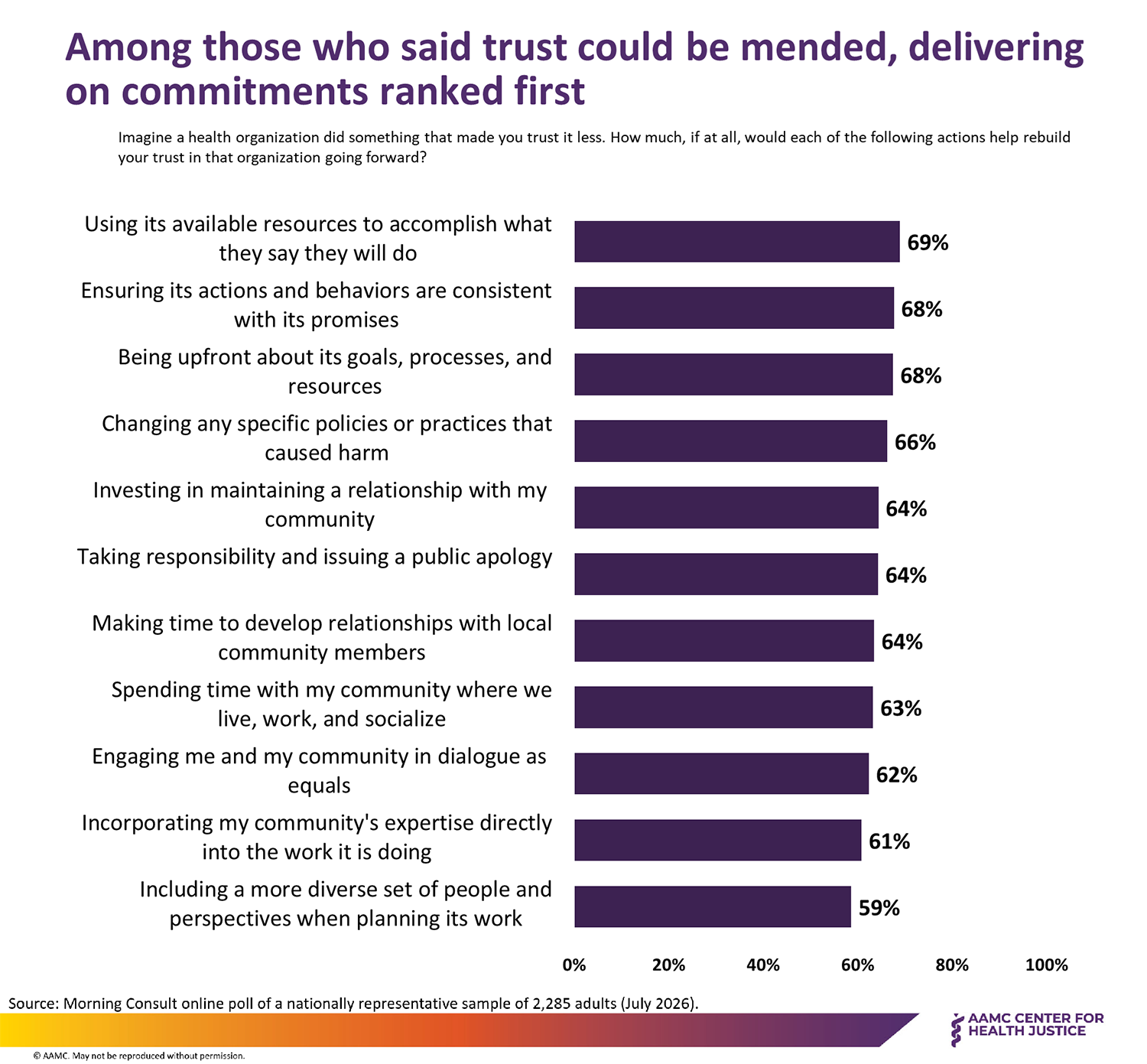
FIgure 4
Finding our way to trust
Half of U.S. adults believe there are organized efforts to make people distrust health institutions and experts, and another 20% are unsure. While all the institutions we assessed were more trusted than not, our 2026 polling found that the steady erosion of trust reported by U.S. adults has continued, and there has been a consistent decrease since 2021 for all types of institutions, save for local schools.
Our data also show that trust in federal agencies is significantly lower than trust in corresponding local organizations,6 a finding in alignment with that of other national polls.7 8 Proximity and familiarity may play a role in this local-federal trust gap, since people hear more about national institutions through polarized and often critical media outlets.20
Importantly, trust in local institutions is not automatically extended to the people working within them. Professionals whose sectors have been under increasing scrutiny — notably public health and science — were significantly less trusted than the local organizations for which they work. At a time when identifying and training “trusted messengers” to counter mis- and disinformation21 is an increasingly common and important tactic, our findings suggest that not all local actors are trusted equally. This supports the need for meaningful community engagement in determining both the messengers and the messages themselves.
We also found that a lack of trust impacts health-related behaviors and actions. Most respondents reported delaying or avoiding at least one health-related action due to a lack of trust, including more than 1 in 6 who avoided going to the doctor. Further, we found that a lack of trust influences behaviors in domains beyond health care: More people avoid tap water (22%) than vaccines (19%).
Yet despite declining trust and its health impacts, our findings suggest that trust can be restored, at least in part, by organizational behavior and action. Most respondents expressed that their trust in hospitals and health care organizations would increase if they knew those organizations invested in community needs beyond medical care, such as housing and food access. This reflects previous Center polling, which found strong, broad endorsement of the vital conditions for health and well-being as essential to the health of respondents’ communities. Nonprofit health care organizations, through their community-benefit and other functions, play a crucial role in the multisector partnerships needed to advance community and population health. Tools like the Center’s Community Impact Tracker can help academic health systems coordinate and communicate their community health work, increasing its effectiveness and ensuring transparency.
For those who indicated trust could be repaired through the broad behaviors in the Principles of Trustworthiness Toolkit, one of the three most frequently selected behaviors was transparency, along with commitment and authenticity. These “key behaviors” are intended as starting points: What transparency looks like for a public health department will be different than what it looks like for a police department, and what works in Boise might not work in Boston. In practice, the toolkit brings communities and institutions together to translate those broad principles into actions that communities themselves recognize as trustworthy. Addressing the concerns of the 56% who did not identify any of the presented actions as a path to repair will require sustained, hyperlocal collaboration, as well as institutions and institutional leaders who are willing to listen, reflect, act, and revisit. Demonstrating trustworthiness has a long arc.
Trust is declining, but it has not run out, and rebuilding it is work that institutions and communities can only do together. “Trustworthiness must precede trust,"22 notes Reuben Warren, DDS, DrPH, professor emeritus and former director of the Tuskegee University National Center for Bioethics. And communities across the country are prepared to define what trustworthy conduct looks like where they live. Close to home, a majority of people still trust their institutions, and the work of rebuilding trust starts on firmer ground than the national conversation suggests.
- Riedl R, Javor A. The biology of trust: integrating evidence from genetics, endocrinology, and functional brain imaging. J Neurosci Psychol Econ. 2012;5(2):63 Back to text ↑
- Reibold K, Bachvarova, Lenard PT. Introduction: trust, social cohesion, and integration. Crit Rev Int Soc Political Philos. 2025; 1-18. [1]Subramanian, SV, Kim DJ, Kawachi I. Social trust and self-rated health in U.S. communities: a multilevel analysis. J Urban Health 79, Suppl 1. 2002;S21-S34 Back to text ↑
- Bi S, et al. Trust and subjective well-being across the lifespan: a multilevel meta-analysis of cross-sectional and longitudinal associations. Psychol Bull. 2025;151(6 ):737. Back to text ↑
- Kawachi I. Social capital and community effects on population and individual health. Ann N Y Acad Sci. 1999;896(1):120-130. Back to text ↑
- Saad L. Confidence in U.S. institutions remains near all-time low. Gallup. https://news.gallup.com/poll/712436/confidence-institutions-remains-near-time-low.aspx. Published July 13, 2026. Accessed Sept. 29, 2026. Back to text ↑
- Bell P. Public trust in government: 1958-2025. Pew Research Center. https://www.pewresearch.org/politics/2025/12/04/public-trust-in-government: 1958-2025. Published Dec. 4, 2025. Accessed Sept. 30, 2026. Back to text ↑
- Deane C. Americans’ deepening mistrust of institutions. Pew Research Center. https://www.pew.org/en/trend/archive/fall-2024/americans-deepening-mistrust-of-institutions. Published Oct. 17, 2024. Accessed Sept. 30, 2026. Back to text ↑
- Musa D, et al. Trust in the health care system and the use of preventive health services by older Black and white adults. Am J Public Health. 2009;99(7):1293-1299. Back to text ↑
- Dean LT., et al. Health care system distrust, physician trust, and patient discordance with adjuvant breast cancer treatment recommendations. Cancer Epidemiol Biomarkers Prev. 2017;26(12):1745-1752. Back to text ↑
- LaVeist TA, Isaac LA, Williams KP. Mistrust of health care organizations is associated with underutilization of health services. Health Serv Res. 2009;44(6):2093-2105. Back to text ↑
- Polinski JM, et al. A matter of trust: patient barriers to primary medication adherence. Health Educ Res. 2014;29(5):755-763. Back to text ↑
- Hall GL, Heath M. Poor medication adherence in African Americans is a matter of trust. J Racial Ethn Health Disparities. 2021;8(4): 927-942. Back to text ↑
- Ding EL, et al. Sex differences in perceived risks, distrust, and willingness to participate in clinical trials: a randomized study of cardiovascular prevention trials. Arch Intern Med. 2007;167(9):905-912. Back to text ↑
- Hurd TC, et al. Building trust and diversity in patient-centered oncology clinical trials: an integrated model. Clin Trials. 2017;14(2):170-179. Back to text ↑
- Wilkins CH. Effective engagement requires trust and being trustworthy. Med Care, Suppl 1. 2018;56(10): S6. Back to text ↑
- Kennedy BR, Mathis CC, Woods AK. African Americans and their distrust of the health care system: health care for diverse populations. J Cult Divers. 2007:14(2): 56. Back to text ↑
- Escobedo LE, Cervantes L, Havranek E. Barriers in health care for Latinx patients with limited English proficiency — a narrative review: Escobedo, et al. J Gen Intern Med. 2023;38(5):1264-1271. Back to text ↑
- Dean LT, et al. Beyond Black and white: race and sexual identity as contributors to health care system distrust after breast cancer screening among U.S. women. Psycho-Oncol. 2021:30(7):1145-1150. Back to text ↑
- Cohn E, et al. Principles of Community Engagement. 3rd ed. Atlanta, GA: Centers for Disease Control and Prevention; 2005. Back to text ↑
- Donovan T, Tolbert C, Bowler S. News they don’t hear: why Americans trust local and state governments more. Political Res Q. 2026; 10659129261447755. Back to text ↑
- Our work. Coalition for Trust in Health & Science. https://trustinhealthandscience.org/our-work. Published Oct. 5, 2024. Accessed Oct.1, 2026. Back to text ↑
- As stated by Warren, et al., 2019. Warren, RC, et al. Clinical trials participation among African Americans and the ethics of trust: leadership perspectives. J Healthc Sci Humanit. 2020;10(1):104. Back to text ↑