

Health equity means we all have a fair chance to be healthy. Every person in every community.
It does not mean equal health outcomes. It does not mean handing out unfair advantage. It does not mean taking health away from one community to give it to another — there is enough health to go around.
Rather, health equity means all communities, whether we define them by geography or demographics, have the basic, fundamental conditions we all need to thrive. Things like humane housing, affordable and high-quality health care, breathable air, freedom from violence, and access to affordable and nutritious food, to name a few. When our communities have those things, everyone in them has a “fair and just opportunity to attain their highest level of health.” That is the very definition of health equity.
Recently the words, concepts, and framing of health equity have been debated and, in many places, erased or replaced. Even though all people and all communities would benefit from health equity, many do not see themselves as beneficiaries of it — and the term and its goal have become controversial.
Or have they?
In late October 2025, the AAMC Center for Health Justice polled a representative national sample of 5,079 adults (ages 18+) in the U.S. general population. Part of our survey focused on the goals and framing of the term “health equity.”
How do people feel about the goal?
First, and without using the words “health equity,” we asked people if they’d ever heard the health care system, public health officials, or the government talk about the goal of “everyone having a fair and just opportunity to attain their highest level of health.” Only 58% of respondents said they had. Those who were younger, male, non-white, identified as politically liberal, had higher income, and had more years of education were significantly more likely to have heard of it. (See Supplemental Tables.)
We asked respondents, regardless of their familiarity with the goal of everyone having a fair opportunity to be healthy, whether they supported it. Seventy-five percent did, and only 3% expressed opposition (the remaining 21% were neutral). That support remained robust no matter how the data were sliced (see Table 1). Yes, there were differences: Asian Americans’ support was stronger than that of other racial/ethnic groups, and baby boomers were more supportive than younger generations were. Nonetheless, the majority of all U.S. adults polled supported a fair opportunity for health.
Table 1: Support for “everyone having a fair and just opportunity to attain their highest level of health”
| Group | Total Support | Total Neutral | Total Oppose |
|---|---|---|---|
| All Adults | 75% | 21% | 3% |
| Men | 78% | 19% | 3% |
| Women | 73% | 23% | 4% |
| Non-Hispanic White | 77% | 19% | 3% |
| Non-Hispanic Black | 71% | 26% | 3% |
| Non-Hispanic Asian American | 84% | 14% | 3% |
| Hispanic | 68% | 27% | 4% |
| Gen Zers | 69% | 25% | 6% |
| Millennials | 73% | 23% | 4% |
| Gen Xers | 75% | 22% | 3% |
| Baby Boomers | 82% | 15% | 2% |
| Liberal | 88% | 10% | 2% |
| Moderate | 75% | 22% | 2% |
| Conservative | 76% | 20% | 4% |
| Income Less Than $50K | 70% | 25% | 5% |
| Income $50K-$100K | 81% | 17% | 2% |
| Income $100K+ | 85% | 14% | 2% |
| Urban | 76% | 21% | 3% |
| Suburban | 78% | 19% | 3% |
| Rural | 70% | 25% | 5% |
| Less Than a College Degree | 71% | 24% | 5% |
| Bachelor’s Degree | 83% | 16% | 2% |
| Postgraduate Degree | 83% | 15% | 1% |
Note: Does not add up to 100% exactly, due to rounding. Margin of error = +/- 1%.
How do people feel about the term?
We then introduced the term “health equity” and asked whether respondents were familiar with it. It was an even split, with 52% reporting some degree of familiarity and 49% expressing a lack of familiarity. The same groups who were most familiar with its goal were also most familiar with the term itself. (See Supplemental Tables.)
Among those who had some knowledge of the term “health equity,” there was significant support for it (65%) and very little opposition (4%) to it. In fact, support for health equity was greater than 50% for all the different groups of U.S. adults we measured, and opposition was very low across the board. (See Table 2.)
Table 2: Support for “health equity”
| Group | Total Support | Total Neutral | Total Oppose |
|---|---|---|---|
| All Adults | 65% | 31% | 4% |
| Men | 67% | 29% | 5% |
| Women | 63% | 33% | 4% |
| Non-Hispanic White | 64% | 31% | 5% |
| Non-Hispanic Black | 69% | 29% | 2% |
| Non-Hispanic Asian American | 77% | 21% | 2% |
| Hispanic | 62% | 32% | 6% |
| Gen Zers | 66% | 29% | 5% |
| Millennials | 67% | 30% | 3% |
| Gen Xers | 64% | 32% | 5% |
| Baby Boomers | 64% | 31% | 5% |
| Liberal | 80% | 19% | 1% |
| Moderate | 66% | 32% | 3% |
| Conservative | 58% | 34% | 8% |
| Income Less than $50K | 59% | 36% | 5% |
| Income $50K-$100K | 70% | 27% | 3% |
| Income $100K+ | 75% | 20% | 5% |
| Urban | 71% | 25% | 3% |
| Suburban | 64% | 31% | 5% |
| Rural | 57% | 37% | 5% |
| Less Than a College Degree | 60% | 35% | 5% |
| Bachelor’s Degree | 72% | 24% | 3% |
| Postgraduate Degree | 76% | 20% | 4% |
Note: Does not add up to 100% exactly, due to rounding. Margin of error = +/- 2%.
Which definition resonates most?
Finally, we presented respondents with three different definitions of health equity and asked which aligned most with their personal values. Definitions that were inclusive, specific, and holistic aligned most with respondents’ values. (See Figure 1.)
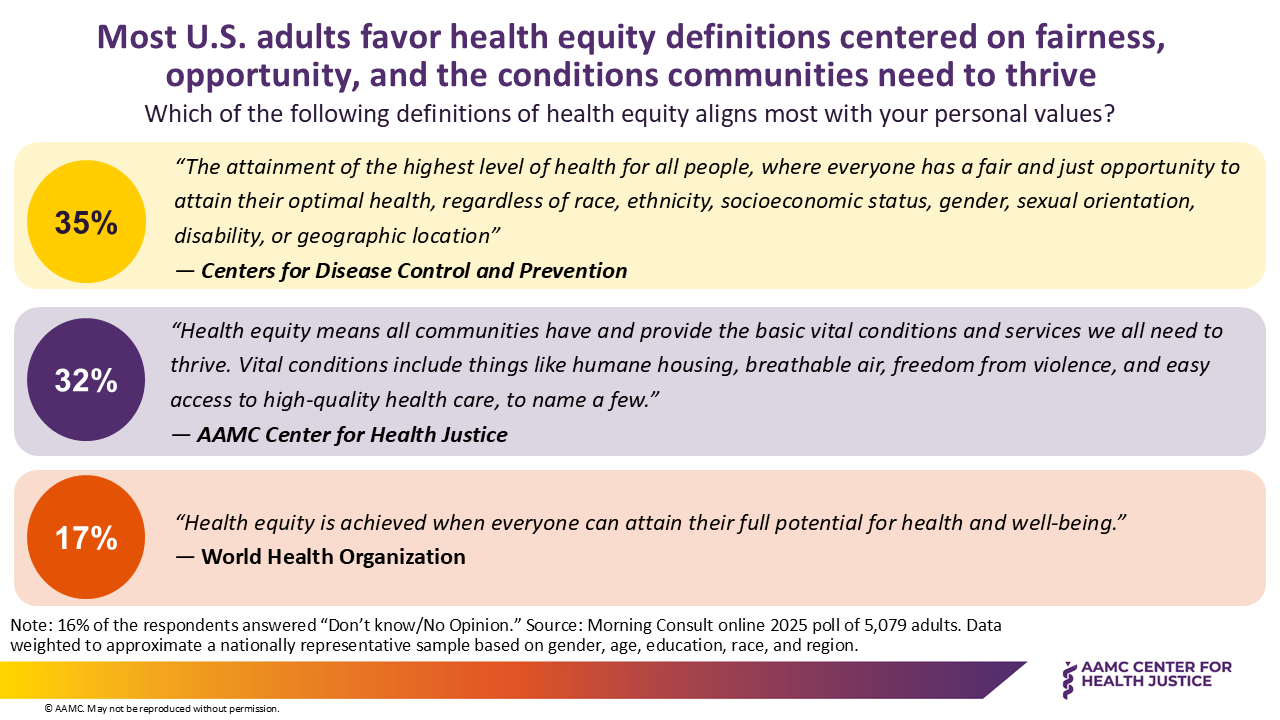
Figure 1
What does this mean?
First, when it comes to health equity, outside of political circles, the current debate might be overstated. Health equity and its goal of all communities having a fair chance to be healthy is supported by a large majority of U.S. adults, regardless of age, race, gender, income, education, or ideology.
While support is stronger for the goal of health equity (75%) than it is for the term itself (65%), the difference seems largely due to awareness and not sentiment: The 10% decrease in support (from 75% to 65%) was mirrored by a 10% increase in neutral responses (from 21% to 31%), while opposition remained low (3% and 4%). A good number of U.S. adults have heard of health equity but don’t yet know enough about it to have an opinion.
Taking action
Therein lies opportunity! Our polling identified groups who were more likely to be unfamiliar with health equity and its goal: older adults, rural adults, moderates and conservatives, and adults with lower income and fewer years of education. And while support was strong across all demographic groups, some groups were less supportive (e.g., Hispanic adults, conservative adults, and those with fewer years of education).
Raising awareness about the goal of health equity and its benefits to all communities should be a priority for those of us working toward a future where all communities thrive. Whether or not we use the term, our results offer insight into how we talk about that goal. We should name specific communities and groups so that people see themselves as explicit beneficiaries. We should describe the tangible assets and vital conditions that communities need to create sustainable opportunities for health. We should engage communication scientists, community organizers and leaders, social media experts, marketers, and others to make sure the right messages reach the right communities: those who are more likely to be neutral or those who are unfamiliar with health equity and its vision. And we must use that same engagement strategy to take the next step: building consensus not just around an already popular goal, but building support for the organizational, local, state, and federal policies that will get us there.
To be effective, this engagement and communication requires that the messengers deployed and the institutions they represent are seen as trustworthy, and AAMC Center for Health Justice polling has found that trust in our institutions is steadily declining. Tools such as our Principles of Trustworthiness Toolkit can help all types of organizations and their community partners define what trustworthy behavior looks like and how to act accordingly.
While our polling shows declining trust, over the years our polls have also reinforced that there is more that unites us than divides us when it comes to topics ranging from environmental justice to civic engagement and, now, to health equity. In this moment of deep division, we can stand firmly on this common ground and, together, build the messages and momentum that move us closer to thriving.
